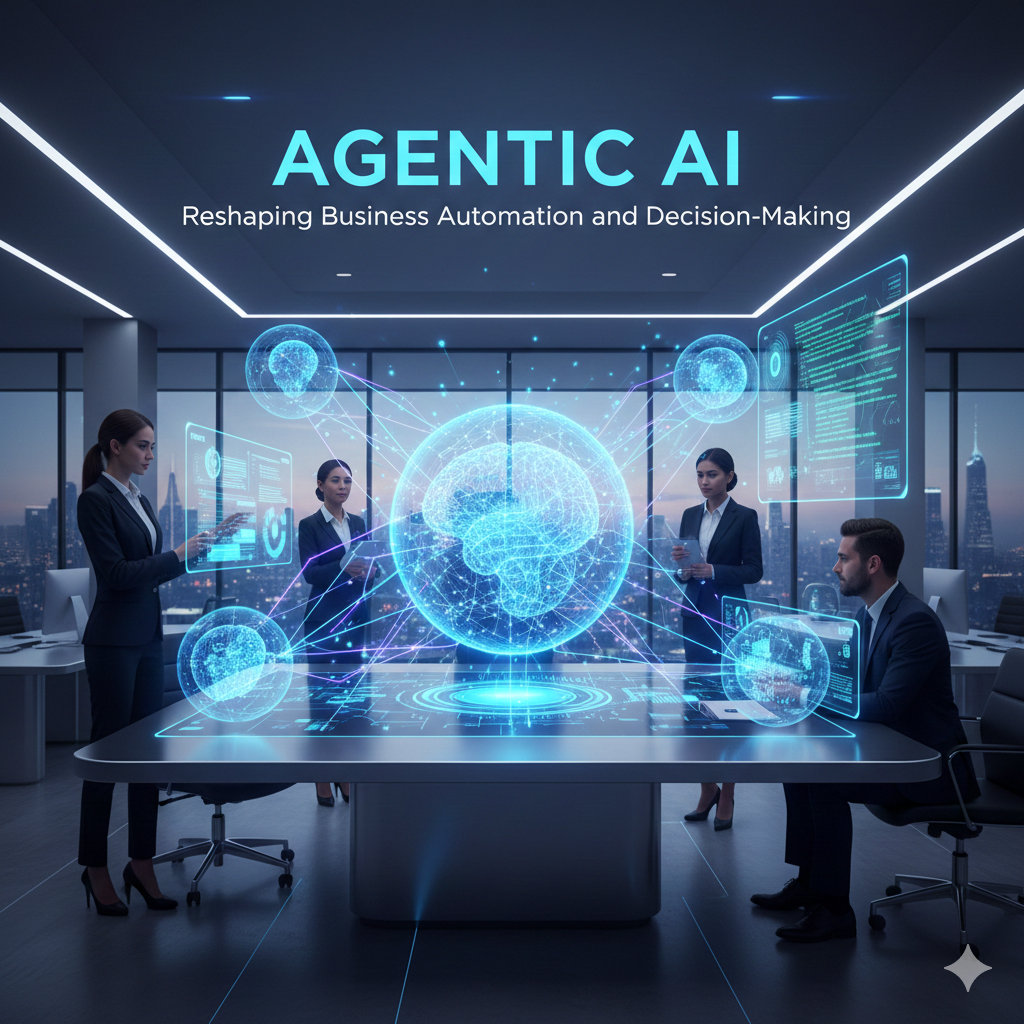
What Is Agentic AI and How It Can Help Your Business
Artificial intelligence has moved well beyond chatbots and recommendation engines. The latest wave — agentic AI — represents a fundamental shift in how machines interact with business processes. Instead of waiting for instructions, agentic AI systems can reason, plan, and act autonomously to achieve specific goals. For businesses of all sizes, this isn't a distant promise. It's happening right now.
Understanding Agentic AI
At its core, agentic AI refers to autonomous AI systems capable of executing specific tasks with minimal human intervention. Unlike traditional AI tools that respond to a single prompt and return a single output, agentic systems can break down complex objectives into steps, make decisions along the way, and take action across multiple tools and platforms.
Think of the difference like this: a conventional AI assistant answers your question. An agentic AI assistant answers your question, identifies three follow-up tasks that need to happen, completes them, and reports back with the results.
These systems are built on large language models (LLMs) but go further by incorporating planning loops, tool usage, memory, and the ability to interact with external software — from CRMs and databases to email platforms and cloud infrastructure.
Why Agentic AI Matters in 2026
The momentum behind agentic AI has accelerated dramatically. Industry analysts project the agentic AI market will grow from roughly $7.8 billion to over $52 billion by 2030. Gartner predicts that by the end of 2026, 40% of enterprise applications will embed role-specific AI agents — up from less than 5% in 2025.
Several forces are driving this rapid adoption:
- Maturity of foundational models: LLMs have become more reliable, context-aware, and capable of multi-step reasoning.
- Standardized protocols: Frameworks like Anthropic's Model Context Protocol (MCP) and Google's Agent-to-Agent Protocol (A2A) are making it easier to connect agents with external tools and with each other.
- Proven ROI: Early adopters are reporting measurable gains — up to 60% fewer errors, 40% faster task execution, and 25% lower operating costs in multi-agent deployments.
The technology has moved past the proof-of-concept stage. 2026 is the year enterprises are operationalizing agentic AI at scale.
How Agentic AI Can Help Your Business
Here are the key areas where agentic AI is making the biggest impact for businesses today.
1. Automating Complex Workflows
Traditional automation tools work well for repetitive, rules-based tasks. Agentic AI goes further by handling multi-step workflows that require judgment calls. An agentic system can ingest a customer request, check inventory, coordinate with a supplier, draft a response, and flag an exception for human review — all without being explicitly scripted for each step.
This is especially powerful in operations, supply chain management, and finance, where processes span multiple systems and require contextual decision-making.
2. Supercharging Customer Experience
Agentic AI is transforming customer service from reactive to proactive. Instead of simply responding to support tickets, AI agents can anticipate customer needs by analyzing real-time signals — purchase history, browsing behavior, even external factors like weather or local events.
In retail, for example, agentic systems are being used to personalize product recommendations, predict demand, and resolve issues before a customer even reaches out. The result is a faster, more seamless experience that builds loyalty and drives revenue.
3. Accelerating Software Development
One of the most visible use cases for agentic AI is in software engineering. AI coding agents can autonomously write, debug, test, and refactor code. Tools like Claude Code have demonstrated the ability to compress development cycles significantly, handling tasks that would take a team days in a matter of hours.
For businesses that rely on software — which is nearly every business today — this translates to faster product iterations, lower development costs, and the ability to do more with smaller engineering teams.
4. Enhancing Decision-Making
Agentic AI can serve as an always-on analyst. By continuously monitoring data streams — financial reports, market signals, operational metrics — an AI agent can surface insights, detect anomalies, and recommend actions in real time. This moves businesses from periodic, backward-looking analysis to continuous, forward-looking intelligence.
Healthcare, finance, and logistics are seeing particularly strong adoption in this area, where timely, data-driven decisions have an outsized impact.
5. Streamlining Internal Operations
HR onboarding, IT support, invoice processing, compliance checks — agentic AI excels at the kind of internal work that consumes enormous amounts of human time but follows recognizable patterns. AI agents can interpret employee queries in natural language, pull information from multiple enterprise systems, and resolve requests end-to-end.
Organizations using agentic platforms for internal operations report significant reductions in resolution time and a better employee experience overall.
6. Scaling Without Proportional Headcount
Perhaps the most compelling business case for agentic AI is the ability to scale operations without linearly scaling your workforce. As AI agents handle more of the routine cognitive work, your human team can focus on strategy, creativity, and the high-judgment tasks that truly require a human touch.
This doesn't mean replacing people. It means allowing your existing team to accomplish significantly more — and freeing them from the repetitive work that leads to burnout.
Key Considerations Before Adopting Agentic AI
Agentic AI is powerful, but deploying it successfully requires intentional planning. Here are the factors that separate successful implementations from failed experiments.
Start With Your Data
Agentic AI is only as good as the data it can access. If your enterprise data is siloed, inconsistent, or poorly organized, your agents will struggle. Leading organizations are investing in data modernization — building knowledge graphs, improving searchability, and ensuring data is structured for AI consumption.
Think in Processes, Not Tools
The most successful agentic AI deployments start by identifying specific business processes that are ripe for automation — not by picking a shiny tool and looking for a use case. Map your workflows first. Identify where bottlenecks, errors, and manual handoffs happen. Then design agents around those pain points.
Governance and Guardrails Matter
Autonomous systems need oversight. Implement clear governance frameworks that define what agents can and cannot do, how decisions are escalated to humans, and how you audit agent behavior. Trust is built through transparency, and enterprises that skip governance often face costly course corrections later.
Plan for Human-AI Collaboration
Agentic AI works best as a complement to your human workforce, not a replacement. The cultural shift required to adopt this technology is often underestimated. Invest in training, change management, and clear communication about how AI agents fit into your team's workflows.
Getting Started
You don't need a massive budget or a dedicated AI team to begin exploring agentic AI. Here's a practical path forward:
- Identify one high-impact, well-defined process — something like invoice processing, customer ticket triage, or report generation.
- Choose a platform that offers pre-built agent capabilities and integrates with your existing tech stack.
- Start small, measure rigorously. Define clear success metrics — time saved, error reduction, cost per transaction — and track them from day one.
- Iterate and expand. Once you've proven value in one workflow, apply the same methodology to adjacent processes.
The organizations that thrive in the agentic AI era share a few common traits: a data-first mindset, a willingness to rethink processes rather than just automate them, and a commitment to responsible deployment.
The Bottom Line
Agentic AI represents the most significant shift in business automation since the rise of cloud computing. It moves AI from a tool you query to a teammate that acts. For businesses willing to invest in the right data foundations, governance frameworks, and cultural readiness, the payoff is substantial: faster execution, lower costs, better decisions, and a workforce freed to focus on what humans do best.
The agentic revolution isn't coming. It's here. The question is whether your business will lead it or catch up to it.