AI Agents in the Enterprise: What's Changed in 2026 and Why It Matters
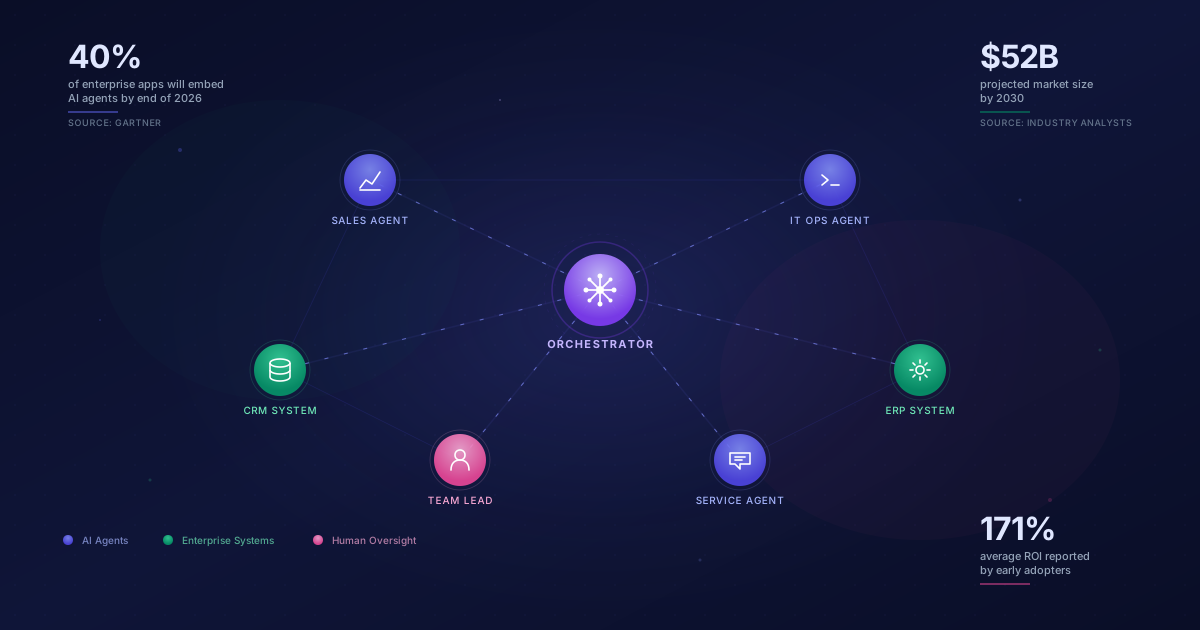
Something significant shifted in the business world this year — and it wasn't another chatbot upgrade. AI agents, the kind that can actually do work rather than just talk about it, started showing up in enterprise software everywhere. Gartner predicts that by the end of 2026, 40% of enterprise applications will include task-specific AI agents, up from less than 5% just a year ago. That's not a gradual climb. That's a tidal wave.
But here's the thing: while the opportunity is massive, so is the risk of getting it wrong. Gartner also predicts that over 40% of agentic AI projects will be canceled by the end of 2027 due to unclear ROI, ballooning costs, or weak risk controls. So how do you end up on the right side of that statistic?
This guide breaks it all down — what enterprise AI agents actually are, where they're delivering real results right now, and what separates the organizations winning with this technology from those burning budget on hype.
What Are Enterprise AI Agents (and What They're Not)
You've probably heard the term "AI agent" tossed around a lot lately. Let's cut through the noise.
An AI agent is software that can pursue a goal across multiple steps — planning what to do, using tools and data, adapting when things change, and completing tasks with minimal hand-holding. Think of it less like a smarter search bar and more like a capable new team member who can log into your systems, pull the data they need, make a judgment call, and get work done.
That's fundamentally different from what came before:
- Chatbots answer questions based on scripts or knowledge bases. They wait for you to ask something, then respond.
- Copilots and AI assistants help you do your work faster — suggesting text, summarizing emails, drafting slides — but you're still in the driver's seat for every action.
- AI agents take the wheel for defined tasks. They reason through problems, interface with third-party services, execute multi-step workflows, and loop in a human only when they need to.
One important caveat: "agent-washing" is rampant. Gartner found that only about 130 out of thousands of vendors claiming "agentic AI" capabilities actually offer the real thing. The rest are repackaging chatbots or basic automation with a trendy new label. If a tool still needs you to click every button and approve every step, it's an assistant — not an agent.
Why 2026 Is the Inflection Point
AI agents aren't brand new. So why is this year different? Three forces are converging at the same time.
The platforms are finally ready. In just the past few weeks, OpenAI launched Frontier, an enterprise platform specifically built to deploy and manage fleets of AI agents across existing business systems. Salesforce rolled out Agentforce with new enterprise licensing models. Google Cloud and Salesforce are collaborating on the Agent2Agent (A2A) protocol, an open standard that lets agents from different vendors work together. Anthropic released Cowork, designed to handle files, documents, and tasks autonomously. Microsoft has Agent 365. The infrastructure for running agents at scale now exists in a way it simply didn't twelve months ago.
The economics are shifting. The traditional SaaS model — where you pay per user seat — starts to break down when AI agents can handle workflows without a human ever logging in. Salesforce introduced an Agentic Enterprise License Agreement (AELA), essentially an all-you-can-eat flat fee for agent-powered services. Other vendors are expected to follow. For business leaders, this means the pricing conversation around enterprise software is fundamentally changing.
The governance tools caught up. One of the biggest blockers for enterprises was the fear of letting AI loose without guardrails. In 2026, platforms now offer built-in identity management for agents (each one gets its own permissions, like an employee ID), human-in-the-loop controls for high-risk decisions, audit trails, and compliance certifications like SOC 2 Type II and ISO 27001. Security is no longer an afterthought — it's baked in.
Where AI Agents Are Delivering Real Results
The hype is loud, but so are the early results. Here's where AI agents are already proving their value across industries.
1. Customer Service and Sales Operations
Global manufacturer Danfoss deployed AI agents to automate email-based order processing. The result: 80% of transactional decisions now happen automatically, and average customer response times dropped from 42 hours to near real-time. On the sales side, a global investment firm used agents end-to-end across their sales process, freeing up over 90% more time for salespeople to spend face-to-face with customers.
2. IT Operations
This is where ROI is clearest. Organizations using AI agents for incident detection and resolution are seeing 30–50% reductions in mean time to repair (MTTR), 20–40% fewer support tickets through proactive monitoring, and SLA compliance improvements jumping from 85% to above 95%. When an agent can detect an anomaly, diagnose the root cause, and resolve it before a human even notices — that's not incremental improvement. That's a different operating model.
3. Manufacturing and Supply Chain
Smart factories running agentic systems report savings of roughly $300 million per year by reducing downtime and eliminating material waste. One semiconductor manufacturer used AI agents to cut chip optimization cycles by orders of magnitude. Energy sector companies are using agents to predict natural disaster impacts and develop mitigation strategies, avoiding millions in potential losses.
4. Internal Productivity
At Telus, over 57,000 team members regularly use AI agents, saving an average of 40 minutes per AI interaction. Brazilian pulp manufacturer Suzano built an agent that translates natural language questions into SQL queries, cutting data retrieval time by 95% across 50,000 employees. These aren't moonshot experiments — they're everyday productivity gains happening at scale.
The Reality Check: Why 40% of Projects Will Fail
For every success story, there's a cautionary tale. Understanding why projects fail is the best way to make sure yours doesn't.
Legacy systems are the biggest technical hurdle. AI agents are non-deterministic — they reason and adapt. Legacy enterprise platforms are deterministic — they run in predictable, repeatable batch cycles. Connecting one to the other is like trying to have a real-time conversation through a fax machine. According to industry surveys, 70% of developers report significant problems integrating AI agents with existing systems, and 42% of enterprises need access to eight or more data sources just to deploy agents successfully.
ROI measurement is broken. A staggering 42% of AI projects show zero ROI — but not always because the technology didn't work. Often, it's because organizations measured the wrong things. Traditional metrics like cost savings or headcount reduction miss the bigger picture: faster decision-making, proactive issue prevention, and revenue opportunities that didn't exist before. When 53% of investors expect positive ROI within six months, there's a dangerous mismatch between expectation and reality for technology that often needs longer to prove its full value.
Cybersecurity remains the top barrier. According to KPMG's Q4 AI Pulse Survey, 80% of business leaders say cybersecurity is the single greatest obstacle to achieving their AI strategy goals. Only 6% of organizations have what could be considered an advanced AI security strategy. And then there's the "shadow agent" problem — over 50% of enterprise AI usage comes from unsanctioned tools deployed by employees without IT approval, creating massive blind spots.
Too many projects are solutions looking for a problem. MIT research shows a 95% failure rate for enterprise generative AI projects that can't demonstrate measurable financial returns within six months. The pattern is familiar: a team gets excited about the technology, launches a pilot disconnected from core business needs, and struggles to justify continued investment when leadership asks for numbers.
How to Evaluate an Enterprise AI Agent Platform
If you're evaluating platforms — or being pitched by vendors — here are the criteria that actually matter.
Governance and auditability come first. KPMG found that 75% of leaders rank security, compliance, and auditability as the most critical requirements for agent deployment. Any platform worth considering should offer granular permissions, full audit trails of every agent action, and human-in-the-loop controls for high-stakes workflows.
Interoperability is non-negotiable. You don't want agents trapped inside a single vendor's ecosystem. Look for platforms built on open standards — the A2A protocol from Google and Salesforce is an early example — that let agents work across your existing tools, whether that's Salesforce, SAP, ServiceNow, or a custom internal system.
Demand proof beyond demos. Ask vendors for case studies with measurable outcomes in your industry. A flashy demo doesn't tell you how the technology performs when it hits your messy, real-world data and systems. KPMG reports that 72% of enterprises plan to deploy agents only from trusted technology providers. Follow their lead.
Understand the total cost. Agent platforms carry costs beyond the license fee — integration work, data preparation, ongoing monitoring, and the human capital needed to manage agents effectively. Constellation Research warns that data access fees and connection costs may become the new version of cloud egress charges, creating hidden expenses that erode ROI if you're not watching.
Preparing Your Workforce for Human-Agent Collaboration
The technology is only half the equation. The human side might be harder.
Entry-level roles are already changing. KPMG's survey found that 64% of organizations have altered their approach to entry-level hiring because of AI agents, up from just 18% one quarter earlier. The skills companies need are shifting — fast. New roles like AI prompt engineer, AI performance analyst, and AI trainer are emerging across industries.
Boards are getting AI-literate. The percentage of leaders who say their board members have substantial AI expertise jumped fivefold in just two quarters — from 8% to 40%. That's a signal that AI governance is becoming a boardroom priority, not just an IT conversation.
Employee resistance is real and valid. As agents take on more responsibility, some employees will feel threatened. The organizations that handle this well are the ones communicating transparently about what agents will and won't replace, investing in continuous upskilling programs, and framing the transition as humans moving from routine execution to higher-level strategic work. Companies willing to pay for this shift are putting their money where their mouth is — 76% of leaders now offer up to 10% higher compensation for candidates with strong AI skills.
Don't underestimate the cultural shift. By 2028, Gartner predicts that 15% of daily work decisions will be made autonomously by AI agents. That fundamentally changes what it means to manage a team, evaluate performance, and allocate responsibility. Organizations that start thinking about these dynamics now — rather than scrambling later — will have a significant advantage.
The Bottom Line
Enterprise AI agents are real, they're delivering measurable results, and they're reshaping how businesses operate. The market is projected to grow from $7.8 billion today to over $52 billion by 2030, and every major technology player is racing to own this space.
But the gap between the companies getting value from agents and those lighting money on fire has never been wider. The difference comes down to discipline: starting with constrained, high-ROI use cases rather than boiling the ocean; investing in data quality and system modernization before deploying agents on top of broken infrastructure; treating governance as a competitive enabler rather than bureaucratic overhead; and preparing your workforce for a future where human-agent collaboration is the norm, not the exception.
The organizations that treat 2026 as the year to move from experimentation to focused execution will pull ahead. The ones still chasing hype will become part of that 40% failure statistic.
The choice — as with most things in business — is about execution, not enthusiasm.
Frequently Asked Questions
What is the difference between an AI agent and an AI assistant?
An AI assistant helps you complete tasks — suggesting responses, summarizing documents, or generating drafts — but you remain in control of every action. An AI agent can independently pursue goals: it plans steps, uses tools and APIs, adapts to changing conditions, and completes multi-step workflows with minimal human involvement. The key distinction is autonomy. Assistants augment your work; agents execute it.
Are AI agents replacing employees in 2026?
Not in the way headlines might suggest. AI agents are primarily taking over routine, repetitive tasks — processing orders, triaging support tickets, monitoring systems — rather than replacing entire roles. KPMG data shows that 44% of leaders expect agents to take lead roles in managing specific projects alongside human teams within two to three years, but the emphasis is on collaboration, not replacement. The bigger shift is in what employees spend their time on, moving from manual execution to oversight, strategy, and exception handling.
How much does it cost to deploy enterprise AI agents?
Costs vary widely depending on scale and complexity. Some organizations launch initial agents within 90 days using modern platforms, while large-scale deployments involve significant integration, data preparation, and governance work. New licensing models like Salesforce's Agentic Enterprise License Agreement offer flat-fee structures that reduce unpredictability. Organizations that report success typically invest not just in the technology but in workforce training, data quality, and ongoing monitoring. Companies deploying agents effectively report an average ROI of 171%, but the 40% project failure rate shows that returns are far from guaranteed without proper planning.
What industries benefit most from AI agents right now?
The strongest early results are in IT operations (incident detection and automated resolution), financial services (fraud detection, compliance, and customer onboarding), manufacturing (predictive maintenance and supply chain optimization), customer service (automated order processing and personalized support), and healthcare and life sciences (regulatory workflows and drug approval acceleration). However, any industry with high-volume, rules-based processes that require cross-system coordination is a strong candidate for agent deployment.